Understanding Risk Management in Trading and Investing (With Indian Market Examples)
Akshay Hedaoo
6/23/20244 min read
Understanding Risk Management in Trading and Investing (With Indian Market Examples)
By Akshay Hedaoo | Founder - Netnium | February 05, 2025


When it comes to trading and investing, profit is the goal—but risk is always a part of the journey. Whether you're buying shares of Indian companies like Tata Motors or trading Nifty options, risk is something you can’t ignore.
That’s why risk management is one of the most important skills for anyone in the stock market. In this blog, we’ll explain what risk management is, why it's important, and how you can manage risk—all in simple English with Indian market examples.
What is Risk in Trading and Investing?
Risk means the possibility of losing money.
Whenever you invest or trade, there is a chance that the value of your investment might go down. For example:
A stock you buy at ₹500 may fall to ₹400
A trade in Bank Nifty options might go against your prediction
A company might post poor results, affecting the share price
These are all types of risks that investors and traders face.
What is Risk Management?
Risk management means:
"Protecting your money by planning how much risk you will take and how you will handle losses."
In simple words, it’s about not putting all your eggs in one basket and being smart with your money.
It includes:
Deciding how much money to invest
Setting a stop-loss
Avoiding emotional decisions
Diversifying your portfolio
Preparing for the worst while hoping for the best
Why is Risk Management Important?
Many beginners in the Indian stock market focus only on profits. But smart investors focus on how to protect their capital.
Without risk management:
You may lose a large amount of money in a single trade
You may panic and make emotional decisions
You may quit the market too early out of frustration
With risk management:
You control your losses
You stay in the market longer
You increase your chances of long-term success
Remember: Even top investors like Rakesh Jhunjhunwala and Warren Buffett have had losing trades—but they managed their risk well.
Types of Risk in the Indian Market
Here are some common types of risks:
1. Market Risk
The overall market falls, and your stocks fall with it.
Example: During COVID-19 in March 2020, Sensex fell sharply.
2. Company-Specific Risk
Only one company’s stock falls due to bad news or poor performance.
Example: If Infosys reports poor results, its stock may fall even if Nifty is rising.
3. Liquidity Risk
You can't sell your shares quickly without a big price change.
Example: Penny stocks often have low volume, making it hard to exit.
4. Volatility Risk
Prices move up and down very fast, especially in options and futures.
Example: Bank Nifty can rise or fall 200 points in minutes during market news.
5. Emotional Risk
You make decisions based on fear, greed, or panic.
Example: Selling good stocks too early or buying high due to FOMO (Fear of Missing Out).
Simple Risk Management Strategies (With Indian Market Focus)
Here are easy ways to manage your risk when trading or investing in the Indian stock market:
1. Never Invest All Your Money in One Stock
Wrong: Putting ₹1,00,000 in one stock like Zomato
Better: Putting ₹20,000 each in 5 different stocks (e.g., TCS, HDFC Bank, Infosys, Titan, Zomato)
This is called diversification. If one stock performs badly, others may balance the loss.
2. Use a Stop-Loss in Trading
A stop-loss is a price at which you exit the trade to avoid bigger losses.
Example:
You buy Reliance at 2,500 ₹.
You set a stop-loss at 2,450 ₹.
If the price falls to 2,450 ₹, you exit the trade with a small loss, not a big one.
Most Indian trading platforms like Zerodha, Upstox, and Angel One offer stop-loss order options.
3. Risk Only a Small Part of Your Capital Per Trade
Don’t risk more than 1–2% of your total capital on a single trade.
Example:
If you have 50,000 ₹ capital,
Risking 2% = 1,000 ₹ per trade
Even if 5 trades go wrong, your loss is limited to 5,000 ₹ (not your entire capital).
4. Invest for the Long Term (in Good Companies)
When investing, choose fundamentally strong Indian companies like:
Infosys
TCS
HDFC Bank
Reliance
Asian Paints
Even if the stock price falls short-term, long-term investors often benefit from growth and dividends.
5. Avoid Trading with Borrowed Money
Never take loans or use margin (borrowed money from broker) unless you're experienced.
Losses with borrowed money can lead to debt and mental stress.
6. Don’t Let Emotions Control Your Decisions
Fear, greed, and overconfidence are enemies of success.
Set rules and follow them:
Decide in advance when to enter and exit
Accept losses calmly
Don’t chase quick profits without a plan
7. Track and Review Your Trades
Maintain a trading journal:
Write down why you entered a trade
What went right or wrong
How you felt during the trade
This helps you learn and avoid repeating mistakes.
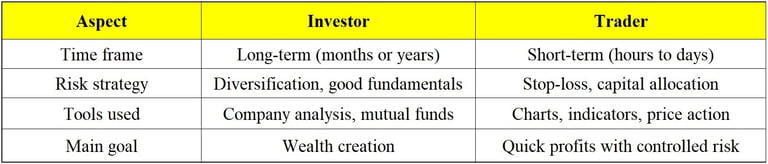
Risk Management for Investors vs. Traders
Final Thoughts
Whether you're investing in Indian stocks, mutual funds, or trading in Bank Nifty, risk management is your best protection. Markets can be unpredictable, but if you follow proper risk control, you’ll stay in the game longer and become a smarter investor or trader.
Key Takeaways:
Risk is part of investing—learn to manage it, not avoid it.
Always have a plan before you enter a trade or investment.
Protect your capital like a business protects its money.
Small, consistent profits with low risk are better than chasing big, risky gains.
Disclaimer: Investment in the securities market is subject to market risks. Please read all scheme-related documents carefully before investing. The information provided in this article is for educational and informational purposes only and is not intended as investment advice. Trading in derivatives, including options, involves substantial risk and is not suitable for all investors. Past performance is not indicative of future results. Readers are advised to consult with their financial advisors before making any trading decisions.